

Full product traceability is becoming a fundamental requirement for modern manufacturing, enabling companies to improve quality control, meet regulatory obligations and achieve greater transparency throughout the supply chain.
A complete traceability system must provide visibility at every stage of production, from individual product identification through to case and pallet level tracking.
AR Automation designs and integrates advanced Track & Trace solutions combining coding and marking, machine vision, automation, data management and factory connectivity technologies.
Traceability in the Smart Factory Environment
The development of Industry 4.0 and connected manufacturing has transformed traceability from a manual recording process into a fully integrated digital system.
Modern Track & Trace solutions use technologies including:
- Industrial coding and marking systems
- Machine vision inspection
- Barcode and 2D code verification
- Industrial automation and robotics
- IIoT connectivity
- ERP, MES and WMS integration
- Real-time production data exchange
- Cloud and database management systems
By connecting production equipment with business systems, manufacturers can achieve real-time visibility of products throughout manufacturing and logistics operations.
Serialisation Systems
Serialisation is the process of assigning a unique identity to every individual product unit through the application of a unique serial number.
This identification is typically applied using a 2D code such as a DataMatrix or QR code, either directly printed onto the product packaging or applied using a printed label.
A complete serialisation system consists of three key elements:
1. Serial Number Management System
The serialisation software generates and manages unique identification numbers and communicates with factory and business systems, including:
- ERP systems
- MES platforms
- Production databases
- Supply chain systems
The system controls the allocation of serial numbers and maintains the digital history of every product.
2. Printing and Application Technology
The unique identification code is applied to the product using suitable industrial printing technology, including:
- Continuous Inkjet (CIJ) printers
- Thermal Inkjet (TIJ) printers
- Laser coders
- Thermal transfer printers (TTO)
- Large character printers
- Print & Apply labelling systems
The printing equipment must operate at production speeds while maintaining reliable data communication with the serialisation system.
3. Code Verification and Inspection
Vision systems verify that every serialised code is:
- Correctly printed
- Present on the product
- Positioned correctly
- Readable and compliant
- Matched against the production database
Only verified products continue through the production process, reducing the risk of incorrect identification and costly recalls.
Aggregation Systems
Aggregation creates the relationship between individual serialised products and their higher packaging levels, such as cartons, cases and pallets.
The aggregation hierarchy typically follows:
Individual product → Bundle/Carton → Case → Pallet
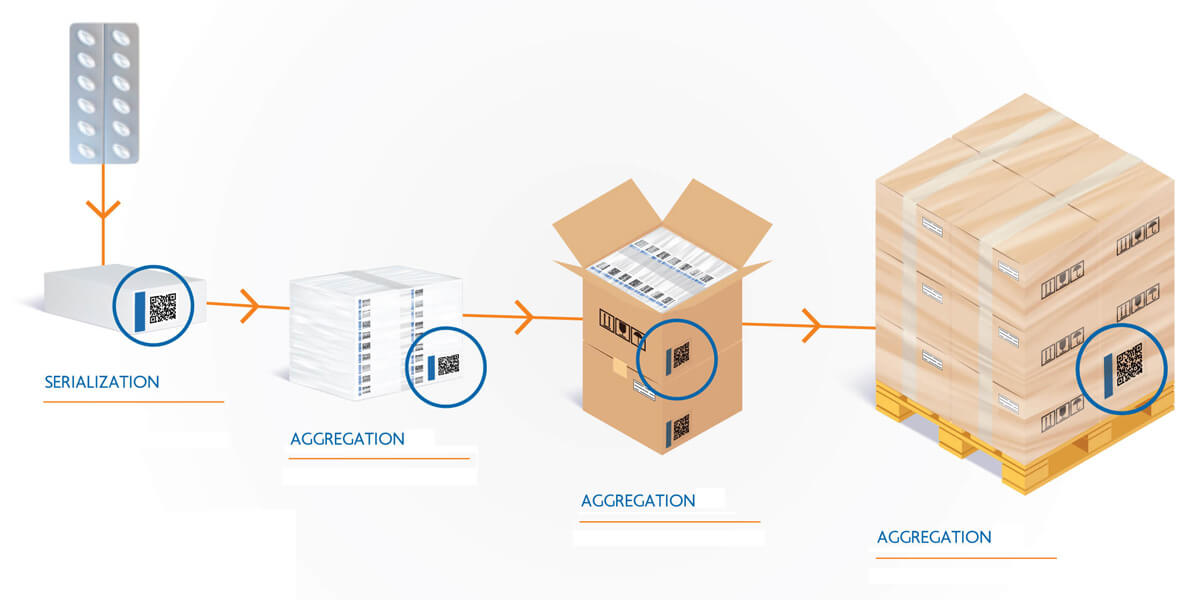
During aggregation, machine vision systems capture and verify the unique codes of individual products as they are packed into cases. The system then creates a digital association between the products and their container.
At pallet level, carton information is linked to a unique pallet identity, creating complete traceability throughout logistics operations.
Aggregation systems provide:
- Automated case and pallet identification
- Real-time data exchange
- Improved warehouse visibility
- Faster product recalls
- Reduced manual scanning requirements
Integration with Production and Business Systems
A successful Track & Trace solution requires seamless communication between production equipment and factory information systems.
AR Automation solutions can integrate with:
- ERP systems
- MES systems
- WMS platforms
- PLC control systems
- Database environments
This enables automatic production order management, online data transfer and real-time reporting of completed production.
Supporting Emerging Identification Standards
Manufacturers are increasingly adopting advanced identification standards, including:
GS1 Digital Link
Enabling products to have a connected digital identity through 2D codes, supporting traceability, regulatory information and consumer engagement.
Falsified Medicines Directive (FMD)
The pharmaceutical industry has implemented mandatory serialisation requirements under the EU Falsified Medicines Directive (FMD), requiring prescription medicines to carry a unique identifier and anti-tampering measures. Serialisation, code verification and aggregation systems enable pharmaceutical manufacturers to verify products throughout the supply chain and support secure product authentication.
Lotify Traceability Requirements
Supporting improved identification and supply chain visibility within beverage applications.
AR Automation helps manufacturers understand and implement these technologies within their existing production environment.
AR Automation Track & Trace Expertise
By combining:
- Coding and marking systems
- Laser coders and industrial printers
- Print & Apply labelling
- Machine vision verification
- Serialisation software
- Aggregation solutions
- Industry 4.0 connectivity
we deliver complete Track & Trace solutions that improve production control, compliance and supply chain visibility.
Discuss Your Track & Trace Requirements
If you are looking to implement serialisation, aggregation, code verification or a complete Track & Trace solution, our specialists can help design the right approach for your production environment.
Complete the contact form below and one of our automation specialists will discuss your requirements.